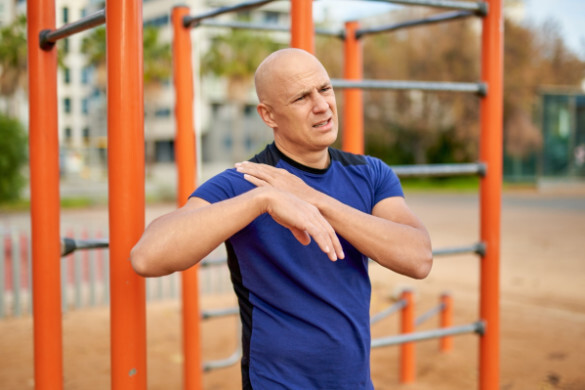
If you have ever dealt with shoulder pain that just will not go away, you are not alone. One of the most common causes of persistent shoulder pain is rotator cuff tendinopathy. While the name sounds complex, it simply means the tendons in your shoulder have become irritated or worn down over time.
This condition can turn everyday movements like reaching into a cabinet, throwing a ball, lifting overhead, or even sleeping on your side into painful and frustrating experiences. Many people try to push through it, assuming it will resolve on its own, only to find the pain slowly getting worse.
At KC Spine and Sport in Overland Park, we see rotator cuff tendinopathy frequently and help patients manage it without surgery in most cases.
What Is Rotator Cuff Tendinopathy
Your rotator cuff is made up of four small but powerful muscles and tendons that work together to stabilize your shoulder and allow you to lift and rotate your arm. When these tendons are repeatedly overloaded, pinched, or weakened, they can develop small areas of damage or gradual degeneration. This process is known as tendinopathy.
Early on, the tendon may become inflamed, which is often referred to as tendonitis. Over time, that inflammation can shift toward tendon breakdown and weakening, known as tendinosis (Lewis, 2016). This gradual change is why symptoms often come on slowly rather than after one specific injury.
Why Does It Happen
Rotator cuff tendinopathy usually develops for two main reasons, overuse and aging.
Repetitive movements such as throwing, swimming, painting, lifting overhead, or working with your arms in front of you for long periods can irritate the rotator cuff tendons, especially if posture or movement mechanics are not ideal (Lewis, 2016).
Aging and overall health also play a significant role. As we get older, blood supply to the tendons decreases, which makes them weaker and slower to heal. People over the age of 50, and those with conditions such as diabetes or high blood pressure, are at a higher risk (Yamamoto et al., 2010).
Lifestyle factors like obesity, smoking, and physically demanding jobs can add even more stress to the shoulder and increase the likelihood of tendon damage (Yamamoto et al., 2010).
What It Feels Like
Most people describe a dull ache along the top or outside of the shoulder that worsens with overhead activity, lifting, or reaching behind the back (Lewis, 2016).
Other common symptoms include shoulder weakness where the arm feels heavy or unstable, pain at night especially when lying on the affected side, and stiffness or catching that makes dressing, lifting groceries, or daily tasks harder.
Because the pain builds gradually, many people tolerate symptoms longer than they should before seeking help.
How Chiropractic Care at KC Spine and Sport Can Help
The good news is that most cases of rotator cuff tendinopathy respond well to conservative care and do not require surgery. Chiropractic care focuses on improving movement, reducing pain, and restoring strength in a way that supports long term recovery.
At KC Spine and Sport, treatment often includes a combination of manual therapy, exercise, and guidance on daily habits that may be contributing to shoulder irritation.
Gentle joint mobilizations and chiropractic adjustments help improve how the shoulder, upper back, and neck move together. Improving this coordination can reduce stress on the rotator cuff and restore more normal motion. Research suggests that combining manual therapy with exercise leads to better outcomes than exercise alone (Littlewood et al., 2013).
Targeted exercise is a key part of recovery. Strengthening the rotator cuff and the muscles that support the shoulder blade helps improve stability and load tolerance. Simple exercises such as resistance band rotations and controlled strength training are supported by strong evidence and are considered the most effective treatment for rotator cuff tendinopathy (Lewis, 2016).
Pain relief modalities such as high level laser therapy or radiofrequency treatments may also be used to calm irritation and allow patients to move and exercise more comfortably. While these tools are not long term solutions by themselves, they can support the healing process when combined with active care (Lewis, 2016).
Posture and lifestyle coaching is another important part of care. Small changes in desk setup, lifting technique, training volume, or sleeping position can significantly reduce stress on the shoulder and help prevent flare ups.
Recovery Takes Time
One important thing to understand is that tendon healing is rarely quick. Recovery often takes weeks or even months, and some research suggests that up to 40 percent of people may still report some level of discomfort after treatment (Lewis, 2016). This does not mean treatment failed, but rather that tendons heal slowly and require consistency.
Sticking with your exercise program and following guidance closely gives you the best chance at long term improvement.
The Bottom Line
Rotator cuff tendinopathy is common and frustrating, but it does not have to control your life. With the right combination of chiropractic care, targeted exercise, and smart lifestyle changes, most people experience meaningful improvements in pain and function.
If shoulder pain is interfering with your sleep, work, or the activities you enjoy, KC Spine and Sport is a great place to start.
KC Spine and Sport | Overland Park, KS
References
Littlewood, C., Malliaras, P., Bateman, M., et al. (2013). The central nervous system and rotator cuff tendinopathy. Manual Therapy, 18(6), 468–472.
Lewis, J.S. (2016). Rotator cuff related shoulder pain: Assessment, management and uncertainties. Manual Therapy, 23, 57–68.
Yamamoto, A., Takagishi, K., Osawa, T., et al. (2010). Prevalence and risk factors of a rotator cuff tear in the general population. Journal of Shoulder and Elbow Surgery, 19(1), 116–120.

Dr. John McNeely
Contact Me