You breathe roughly 20,000 times a day. Most of those breaths are doing less work than they should.
That's not a knock on you. Nobody teaches this stuff. But if you've dealt with low back pain, feel unstable under load, or keep hitting a wall with your strength training, there's a good chance your breathing mechanics are part of the problem.
Here's what's actually going on.
What diaphragmatic breathing is and why it matters
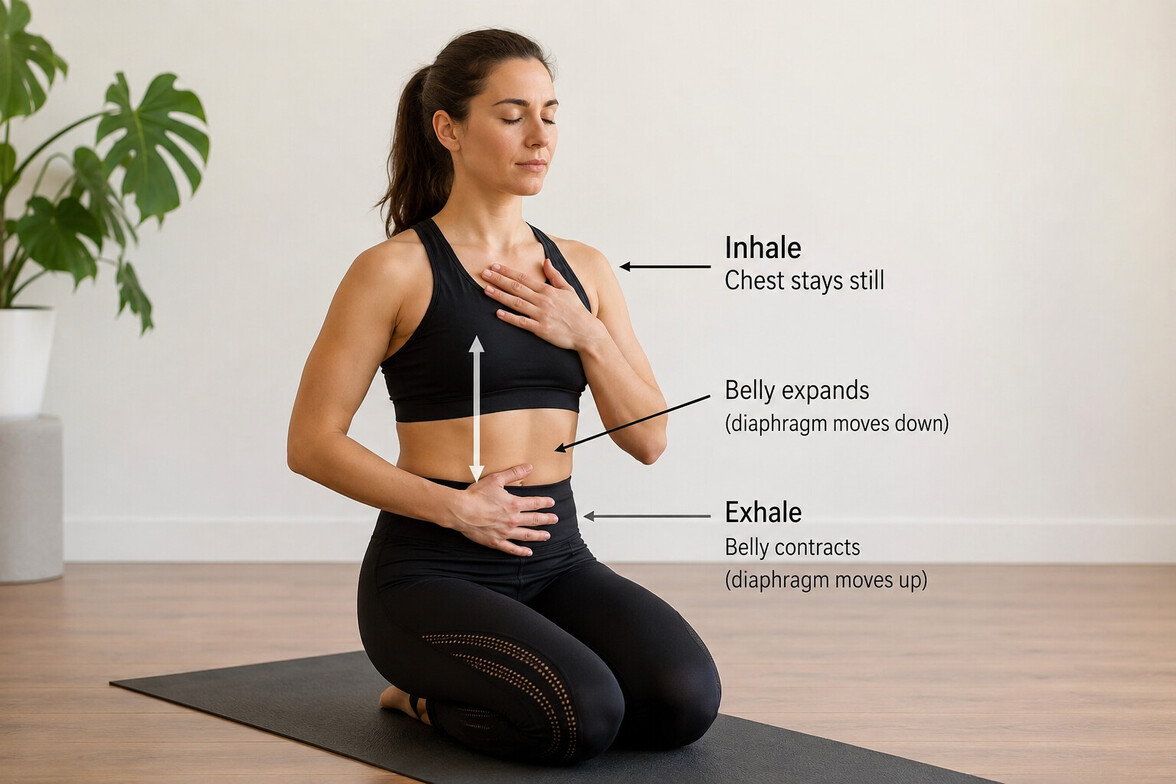
Your diaphragm is a dome-shaped muscle that sits below your lungs. When it's working correctly, it descends as you inhale and creates 360 degrees of expansion through your belly, sides, and lower back. Not just your chest. Not just your stomach. All the way around.
Watch a baby sleep and you'll see exactly what this looks like. The belly rises and falls. No chest heaving, no shoulder shrugging. Just the diaphragm doing its job.
Most adults lose this pattern somewhere along the way. We become chest breathers. Shallow, quick, upper-body dominated. And that shift costs us more than most people realize.
What intra-abdominal pressure actually is
When your diaphragm descends and your core muscles and pelvic floor respond the way they're supposed to, the pressure inside your abdominal cavity increases. Think of it as an internal weight belt. That pressure stabilizes your spine and pelvis before any movement happens, so your arms and legs can generate force without your lower back absorbing the cost.
This is what we're talking about when we say brace before you lift. Not sucking your stomach in. Not squeezing your abs as hard as you can. Creating pressure throughout the entire trunk so the spine is supported from the inside out.
Why this matters for your back
Spinal stability doesn't come from gripping your muscles or stiffening up. It comes from properly regulated internal pressure. When that pressure system isn't working right, your body compensates. It over-braces. It shifts load to the wrong structures. It develops the kind of movement patterns that quietly build toward injury over months or years.
Most of the low back pain I see in the clinic has some component of poor trunk stability underneath it. And poor trunk stability almost always traces back to breathing mechanics that aren't doing their job.
Why this matters for your performance
Every time you squat, deadlift, carry, throw, or sprint, your body needs a stable base to push against. Without adequate intra-abdominal pressure, you're essentially trying to generate force through an unstable foundation. You might compensate well enough to get through the movement, but you're leaving strength on the table and accumulating stress in places that weren't meant to handle it.
Athletes who learn to breathe and brace correctly move more efficiently, produce more force, and stay healthier over time. It's not a minor detail. It's the foundation everything else is built on.
How to start building it
Lie on your back with your knees bent. Place one hand on your chest and one on your belly. Breathe in through your nose and focus on pushing your belly toward the ceiling first. Your chest should barely move. Breathe out slowly through your mouth. Do this for two to three minutes and pay attention to how different it feels from your normal breathing pattern.
Once that becomes automatic on your back, work on it seated, then standing, then under load. The goal is to make it your default before any heavy movement, not something you have to think about.
This is one of the first things I work through with patients who come in with back pain or movement limitations. It sounds basic. It usually isn't. Most people have to relearn it from scratch.
If you want to know whether your breathing mechanics are contributing to pain or limiting your performance, that's exactly the kind of thing we assess at KC Spine and Sport.

Dr. John McNeely
Contact Me